1,500 Marines Watched a 0-0 Score at the Guadalcanal Football Game
A 1944 match on a Pacific island offered a brief break before 15 of the 65 players were killed in action at Okinawa.
By Olivia Reed ·
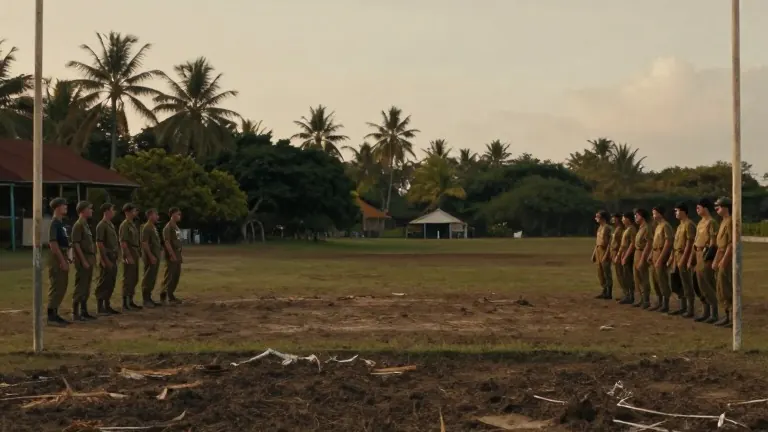
On Christmas Eve 1944, 1,500 Marines gathered on a field of packed earth and broken coral on Guadalcanal to watch two regiments of the 6th Marine Division play football.
The game ended in a 0-0 tie. The men had spent months drilling on the island, which served as a staging ground for the Pacific War after the first major American offensive there had quieted down nearly two years prior.
Director Peter Berg adapted the event for the film The Mosquito Bowl, which opened in select theaters on Oct. 30 and is scheduled for a wider release on Nov. 25 via Netflix. The film is based on a book by Pulitzer Prize-winning journalist Buzz Bissinger.
The movie follows four specific players: John McLaughry, Dave Schreiner, Bob Bauman, and Tony Butkovich. All four were college football stars before the war. Schreiner was a two-time All-American at the University of Wisconsin and the Big Ten’s most valuable player in 1942. The Detroit Lions had drafted him.
Bauman was a tackle from Harvey, Ill., and a teammate of Schreiner. Butkovich played for Illinois and later Purdue, rushing for 833 yards in seven games in 1943 before the Marines drafted him. McLaughry was the oldest of the group, having played for the New York Giants and captained his father’s team at Brown University.
The game originated from an argument among former college players who wanted to settle which regiment had the better team. Major General Lemuel Shepherd, the division commander, approved the event to boost morale. He believed that when Marines worried about death, they needed a diversion.
The Marines built their own goalposts and wore numbered T-shirts and cut-off dungarees. An announcer called the game over the Mosquito Network, a radio system that broadcast to ships and islands across the Pacific. The coral in the dirt often drew blood as players ran the field.
Three months after the game, the 6th Marine Division sailed for Okinawa. Fifteen of the 65 men who played in that Christmas Eve match were killed in action there. Schreiner, Bauman, and Butkovich all died on Okinawa. McLaughry survived and lived to age 90.
The division arrived in Okinawa on April 1, 1945, the largest landing of the Pacific War. The fighting continued for months. By late June, more than 12,000 Americans were dead or missing, and nearly three times that number were wounded. Estimates of the Okinawan civilian dead range from 94,000 to 140,000.
The heaviest fighting for the division occurred at a hill called Sugar Loaf. It stood about 50 feet high and sat between the troops and the capital city of Naha. Japanese guns covered the hill from three directions. It changed hands repeatedly. In the 10 days before the Marines finally secured the position on May 18, 1945, more than 2,600 men from the division were killed or wounded.
Source: Time · original report published
More Sports · Cleveland news · Report a business · Got a Story?