Gulf diplomats push Iran for security pact
Saudi Arabia, Pakistan, and Turkiye met in Tehran as Qatari mediators delivered a draft deal facing stiff resistance on nuclear terms.
By Michael Collins ·
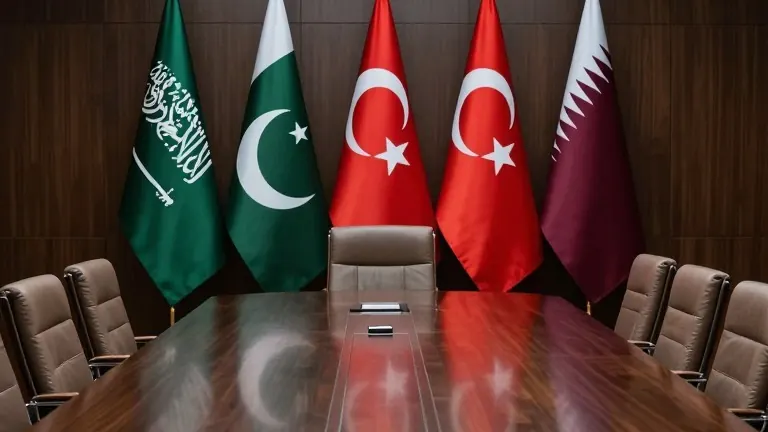
Saudi Minister of Defence Prince Khalid bin Salman Al Saud traveled to Tehran on Monday to meet with high-ranking Iranian officials. He was joined by delegations from Pakistan, Turkiye, and Qatar, the three nations that signed the Mecca Joint Defence Agreement in August. The gathering marked the first high-level contact between Iran and these Mecca pact signatories since the US-Israel war on Iran began on February 28.
The timing of the visit underscored the fragility of the regional ceasefire. Just days before the meeting, Iran-aligned Houthi fighters attacked Saudi airports, ports, and oil facilities. These strikes followed a period where hostilities restricted passage through the Strait of Hormuz and disrupted global energy supplies.
During a separate visit to Cambridge, England, Omani Foreign Minister Badr Albusaidi proposed a new regional security framework. He called for a non-aggression pact between Gulf countries and Iran that would shift the primary security provider role away from the United States. This idea aims to create a structure where regional neighbors guarantee each other’s safety without relying solely on American military power.
Qatari mediators presented a draft deal to Tehran on Sunday. Iranian officials indicated on Wednesday that the proposal contained ideas they found unacceptable. Tehran stated it would show no flexibility regarding the nuclear issue and expected to respond to the draft by the end of the week.
Khaled Batarfi, a Saudi political analyst, described the Saudi visit as an attempt to give Iran a last warning. He noted that while Riyadh is willing to submit to regional concerns, Iran has so far refused to engage fully. Batarfi told Al Jazeera that the gap between the parties is wide and that a lack of trust makes the situation worse.
Hamidreza Azizi of the International Crisis Group identified the core obstacle as a disagreement over the sequence of commitments. The United States wants Iranian concessions, particularly on nuclear matters, before ending the conflict. Tehran insists its conditions for ending the war must be met first. Azizi noted that while regional mediation might help bridge this gap through an interim arrangement, the principal parties have not yet shown the necessary willingness to compromise.
Analysts question whether the Gulf states share a unified vision for this new security order. Aniseh Bassiri Tabrizi, an associate fellow at Chatham House, stated that it is difficult to see a formal regional security framework emerging in the coming months. She observed that current diplomatic efforts involve small, flexible groups seeking bilateral solutions rather than a cohesive multilateral bloc.
The United States remains the main security partner for the Gulf Cooperation Council, and Gulf states remain deeply integrated into that system. Azizi said the recent war raised questions about American reliability but encouraged diversification of partnerships rather than a fundamental redefinition of strategic alignments. Pakistan, Saudi Arabia, and Turkiye share concerns that a prolonged confrontation between Iran and the US could further destabilize the region.
Source: Al Jazeera