
Crimean Drone Hub Resists Ukrainian Strikes
Satellite data reveals why the Hvardiyske airfield remains an active launch site despite repeated missile attacks.
By Olivia Reed ·
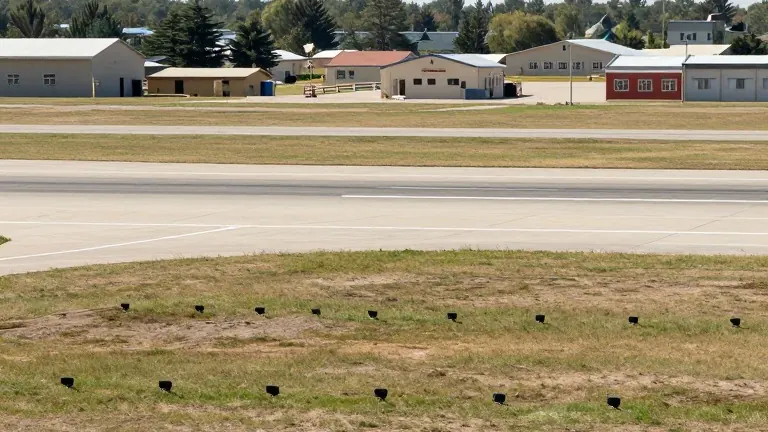
Russian forces have converted the Hvardiyske airfield in central Crimea into a high-frequency drone launch hub, according to new satellite imagery. The site, known as Gvardeiskoye in Russian, was first identified as a launch point in March 2025. Ukrainian military officials state the base now supports almost daily strike operations.
An image captured on October 11 shows no visible military aircraft at the facility. Instead, the photo reveals extensive new infrastructure linked to drone operations. Scores of unidentified objects are spaced several meters apart on open grassland in the southwestern corner of the base. Observers note that the layout differs from traditional airfield configurations.
Ukraine has successfully targeted other drone facilities in Crimea, including sites at Cape Chauda and near Balaklava. Those strikes reportedly disabled the locations. Hvardiyske has also been hit by Ukrainian drones, but damage assessments indicate the site has sustained minimal impact. The persistence of the base has prompted analysis of its defensive advantages.
A former Ukrainian military officer living in Crimea spoke on condition of anonymity about the site's resilience. He attributed the difficulty of disabling the base to the dispersion of its operational components. “In my opinion, the main reason is that drone operations there are spread across different parts of the airfield,” he said. He noted that launch sites, maintenance areas, and storage facilities occupy distinct locations.
The former officer described the infrastructure as relatively simple and easy to restore. He pointed to an underground Soviet-era munitions storage facility located approximately 15 kilometers from the base as a likely location for mass drone storage. “The Shaheds may well be hiding there,” he said, adding that such fortified spaces are difficult to penetrate even with missiles.
Geography presents another challenge for Ukrainian strike planners. Unlike coastal sites that can be approached from the sea, Hvardiyske sits in the center of the peninsula. The region is densely covered with air defense systems. According to the source, drones must fly about 100 kilometers over land to reach the target, increasing the probability of interception.
The airfield has a long history as a naval aviation base for the Soviet Union and later Ukraine. After Russia annexed Crimea, the Russian Aerospace Forces took control of the facility. Su-24M bombers and Su-25SM ground-attack jets were stationed there prior to the current transformation into a drone port.
Source: RFE/RL