
European Security: Ukraine Accuses Russia of Sinking Four Cargo Ships Near Bulgaria
Moscow’s suspected shadow war includes drone incursions over NATO airspace and sabotage in the Baltics, as Kyiv seeks 70 billion euros in additional aid for 2026.
By Sofia Morales ·
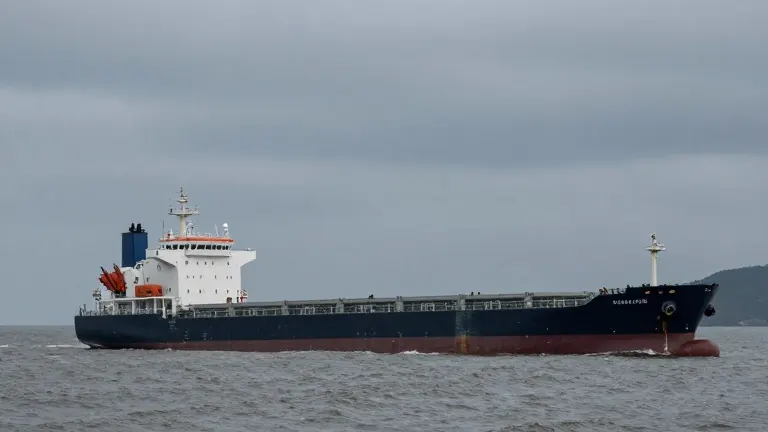
Ukrainian officials accused Russia of sinking four cargo ships in two separate operations this month just outside the territorial waters of Bulgaria. The vessels were attacked by aerial and surface drones, according to Ukraine, which framed the strikes as a warning that grain exports through NATO waters are no longer safe. Bulgaria is a member of both the European Union and NATO.
The incident is part of a wider pattern of alleged Russian activity across Europe. European officials report that Russian fighter planes have veered into the airspace of Poland, Lithuania, and Estonia. Suspected Russian drones have been downed over Poland, Finland, and the Baltic states. In Germany, a verified Russian operation in August targeted cargo planes at Leipzig/Halle Airport.
In the Baltic region, Latvia’s ambassador to Greece, Ieva Cesniece, described a coordinated effort to destabilize the border with Belarus. She stated that masked individuals on the Belarusian side escorted groups of migrants into Latvia and threatened Latvian soldiers. On the same day, masked figures crossed into Latvian territory to damage border infrastructure and remove surveillance equipment. Latvian media reported that Belarusian authorities rounded up asylum seekers who tried to return and pushed them back toward Latvia.
Cesniece linked these actions directly to the war in Ukraine. She said, “The weaker Russia appears in Ukraine, the more it tests our resilience, trying to weaken NATO and EU resolve and support for Ukraine.” Experts suggest that Russia is testing the bloc’s reaction times and willingness to escalate.
Olena Tregub, cofounder of Ukraine’s Independent Anti-Corruption Commission, argued that Europe has not imposed enough costs on Moscow. She noted that deterrence requires convincing an adversary that operations are too expensive to continue. Tregub observed that Russian officials do not distinguish between Ukrainian military capabilities and the European infrastructure that supports them. Factories, logistics hubs, and technology providers are all potential targets.
Intelligence reports have intensified concerns about further escalation. Representatives of five EU intelligence agencies told the Financial Times that Russia is seeking to target European defense executives and supply chains. This follows reports that Russia planted incendiary devices in Munich offices of defense companies Rohde & Schwarz and Helsing. Czech spy chief Michal Koudelka warned in September that a military attack on a NATO member could happen in months rather than years.
Russian Foreign Ministry spokesperson Maria Zakharova declared that European defense industries supplying Ukraine are legitimate targets. Oleksandr Danylyuk, a Russian warfare expert, stated that Russia is currently limited only by its own capabilities because it faces no reaction. He advocated for NATO to place more forward troops in the Baltics to create deterrence by denial.
The financial stakes are high as the war continues. Ukrainian President Volodymyr Zelenskyy told the European Council on October 16 that the war will cost 155 billion euros next year. He requested at least 70 billion euros in additional support from Europe. Zelenskyy noted that with more funding, Ukraine could double or triple its drone production to increase pressure on Russia.
Ukraine has maintained its position on the ground through two counteroffensives that blunted Moscow’s advance in the Donetsk region. The country has also struck oil installations and weapons factories deep inside Russian territory. Zelenskyy asked journalists on October 16 if Russia would stop testing drones against NATO countries. He predicted that Europe would speak more loudly when ballistic and cruise missiles arrive.
Minna Alander of the Center for European Policy Analysis listed realistic retaliations Europe could impose immediately. These include denying travel visas, conducting retaliatory cyberattacks, interdicting the Russian oil fleet, and sanctioning Chinese suppliers of defense goods. Danylyuk suggested that increasing support for Ukraine by 10 to 20 percent each time a Russian intelligence operation is detected would serve as a direct punishment.
Source: Al Jazeera