Tesla's Subscription Driving Service Attracts Older Drivers
An 89-year-old Colorado resident relies on the system to remain in her home, while safety researchers debate the risks of complacency.
By Daniel Parker ·
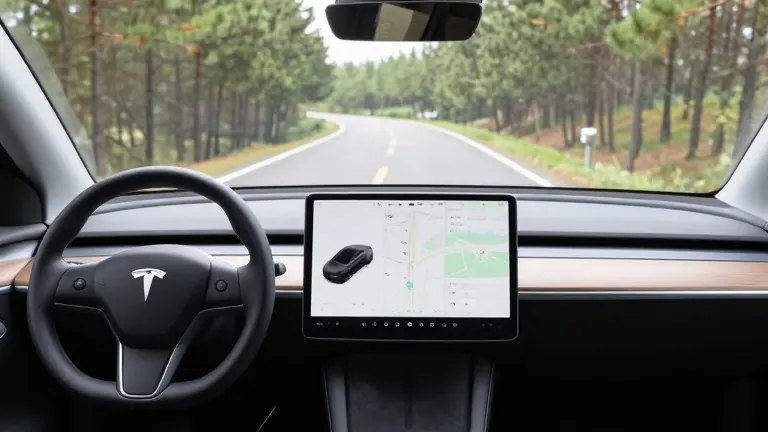
Joan Spalding, 89, rarely touches the steering wheel of her Tesla Model Y as it travels the steep, winding road to her home outside Denver, Colorado. She enters her destination on the dashboard touch-screen and presses a button to engage the car's automated driving system. The vehicle handles the tight turns and narrow dirt track without input from Spalding, stopping only to yield to an oncoming SUV.
Spalding describes the experience as simple. "I just get in and go," she said. Before purchasing the Tesla two years ago, she was involved in several minor accidents. A serious crash during a left turn led her to question her own driving ability. Her son, Mike Spalding, suggested the Tesla. He noted that the car's safety features would protect his mother in a collision and reduce the risk of future crashes. "It's better than me," he said.
Tesla's system is known as Full-Self Driving (Supervised), or FSD. It is a subscription service that costs $99 per month. Tesla reports more than 1.7 million active subscriptions, a 67% increase from a year earlier. The company has not disclosed how many of those subscribers are seniors, nor has it stated whether it tracks that specific demographic. Elon Musk, Tesla's CEO, has encouraged older drivers to use the technology. Last month, he reposted a video on his social media platform X featuring Larry Dimmock, a 98-year-old driver in his first Tesla. Musk captioned the post, "At Tesla, we even care about the chipmunks," referencing a moment where the car stopped for a small animal. The video has been viewed more than 3.5 million times.
Dimmock said the system has been flawless for the two or three months he has used it. He believes he feels safer in the car than when driving other vehicles or riding with other people. "I'll get in the car and go somewhere, otherwise, I probably wouldn't," Dimmock said. Spalding agreed, stating that the technology allows her to live independently in the house she and her late husband built. Without the automated driving, she said, she would likely have to move to a residence that did not require driving.
Safety experts, however, express concern about the name and the user experience. Bryan Reimer, a research scientist at MIT, said he would not drive with the system or recommend it to loved ones due to safety gaps. He noted that Tesla has not released enough data to independently verify its claim that FSD is up to nine times safer than human driving. Reimer criticized the naming convention. "Full self-driving is not full self-driving, but yet the name feels so real," he said. He added that Tesla has continually over-promised and under-delivered.
The fine print requires the driver to supervise the car at all times. Alexandra Mueller, a senior research scientist at the Insurance Institute for Highway Safety, said human drivers often become complacent because the system handles common situations correctly. She worries that older drivers may not be able to take control quickly if the car encounters an unfamiliar scenario. "This can be a huge problem," Mueller said. "Ultimately it is very unsafe if you have drivers who are not fully competent due to age-related impairments or decline."
Tesla did not reply to requests for comment regarding its safety data or the senior demographic. The company uses the full title FSD (Supervised) in official communications to clarify the driver's role. For Spalding, the benefit outweighs the risk. She plans to continue using the system to maintain her independence. "I don't see any reason why not," she said.
More News · Cleveland news · Report a business · Got a Story?