Battle Reenactment Marks 250th Anniversary
Approximately one thousand spectators gathered at Orchard Beach Park on Sunday to observe a commemoration of the 1776 engagement at Glover’s Rock.
By Michael Collins ·
Orchard Beach Park in the Bronx hosted a large-scale historical reenactment on Sunday, October 18, 2026. The event marked the 250th anniversary of a pivotal engagement that took place near Glover’s Rock. Local historical societies, civic groups, and schools sponsored the gathering. Around one thousand people attended the proceedings.
The original battle began at dawn on October 18, 1776. Four thousand British and Hessian soldiers marched along a narrow country road that followed the high ground where the rock now sits. They aimed to encircle General George Washington’s army from the east. Washington’s forces were attempting to escape a dangerous position on Manhattan and cross the Hudson River into New Jersey. The rock, a glacial erratic boulder, now has an identifying marker from the Parks Department next to a road pullout.
Colonel John Glover commanded the American defense. He led eight hundred men, organized into four regiments. The troops held defensive positions along the road against odds of five to one. Glover’s New England units served as both infantry and watermen, providing whaleboats and oarsmen for Washington. The boat depicted in the painting “Washington Crossing the Delaware” belonged to these troops. Glover ordered three regiments to hide behind stone walls lining the road. An advance guard formed near the rock, while the fourth regiment stayed in reserve farther back.
Sunrise occurred at 6:32 a.m. in 1776, according to contemporary sources. On the 2026 anniversary, first light appeared at approximately 6:30 a.m. A Y-shaped streetlight cast a bluish glow over the boulder and adjacent lawn. Four deer emerged from a nearby reed thicket, and two Canada geese flew overhead. The sun rose fully over Long Island Sound at 7:11 a.m., breaking through the tree line.
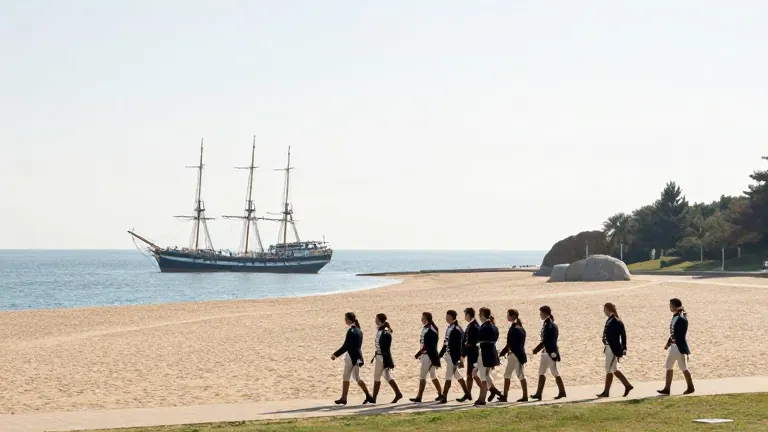
The reenactment began by 10 a.m. due to logistical requirements for the location. A two-masted schooner named the Lynx anchored offshore in a mild breeze. Reenactors dressed as British soldiers rowed from the ship to the beach in a dory. A U.S. Coast Guard member on the beach in a life vest stated, “They don’t want to get wet,” as the soldiers disembarked. Other reenactors arrived by car and parked in the vast Orchard Beach lot.
The British and Hessian forces formed ranks on the lawns. They marched up a service road with bulletless muskets. Sean Grady, of Westchester, led the Continental reenactors while impersonating Colonel Glover. Grady adopted a Boston accent and shouted, “We cannot expect any rein-fahce-ments!” The two sides exchanged smoky volleys of black powder. Glover’s men retreated and reformed while the British continued their advance.
The battle concluded with the American forces retreating across the Hutchinson River. A narrator announced the end of the event via loudspeaker. Reenactors and attendees mingled cheerfully on the promenade. Four or five participants played the role of fallen soldiers. They remained sprawled on the ground even after the announcement. Their period-accurate uniforms featured modern rubber soles. Some appeared to be teenagers, lying still in the grass as spectators moved around them.
Source: The New Yorker · original report published
More News · Cleveland news · Report a business · Got a Story?